
A boy’s bedroom can go from tidy to chaotic surprisingly fast. A few books land on the floor, yesterday’s clothes end up on a chair, building blocks spread across the rug, and suddenly the room feels much smaller than it actually is.
The answer isn’t necessarily more storage.
What usually helps more is putting the right kind of storage in the right place. Toys need to be easy to put away. Books should be within reach. Everyday clothes need a home that doesn’t require a complicated organizing system.
Whether you’re working with a small bedroom or simply trying to make cleanup easier, these practical storage ideas can help create a room that feels calmer, functions better, and is easier for a child to maintain.
1. Use Low Storage Bins for Everyday Toys
For toys that come out almost every day, convenience matters more than perfect organization.
Low bins or baskets make it easy for kids to see what they have, grab what they want, and—most importantly—put everything back without help.
They work especially well for:
- Building blocks
- Toy cars
- Action figures
- Stuffed animals
- Balls
- Pretend-play toys
Instead of creating a separate container for every tiny category, start with a few broad groups. A storage system that takes five seconds to use is much more likely to stay organized than one that requires sorting 20 different types of toys.
For younger children, open bins are often easier than containers with lids.
Practical tip: Measure the available space before buying baskets or bins. Three containers that fit neatly on a shelf are usually more useful than six mismatched containers scattered around the room.
2. Turn the Space Under the Bed Into Storage
The area beneath a bed is valuable real estate, particularly in a small bedroom.
Low-profile storage containers can hold things that don’t need to be accessed constantly, such as:
- Out-of-season clothes
- Extra bedding
- Larger toys
- Sports equipment
- Puzzles and board games
- Keepsakes
Clear containers make it easier to see what’s inside, while fabric or solid-colored bins can create a cleaner appearance.
If you’re buying under-bed storage, don’t rely on the manufacturer’s description alone. Measure the actual clearance between the floor and the bed frame first.
A container that’s two inches too tall isn’t much of a storage solution.
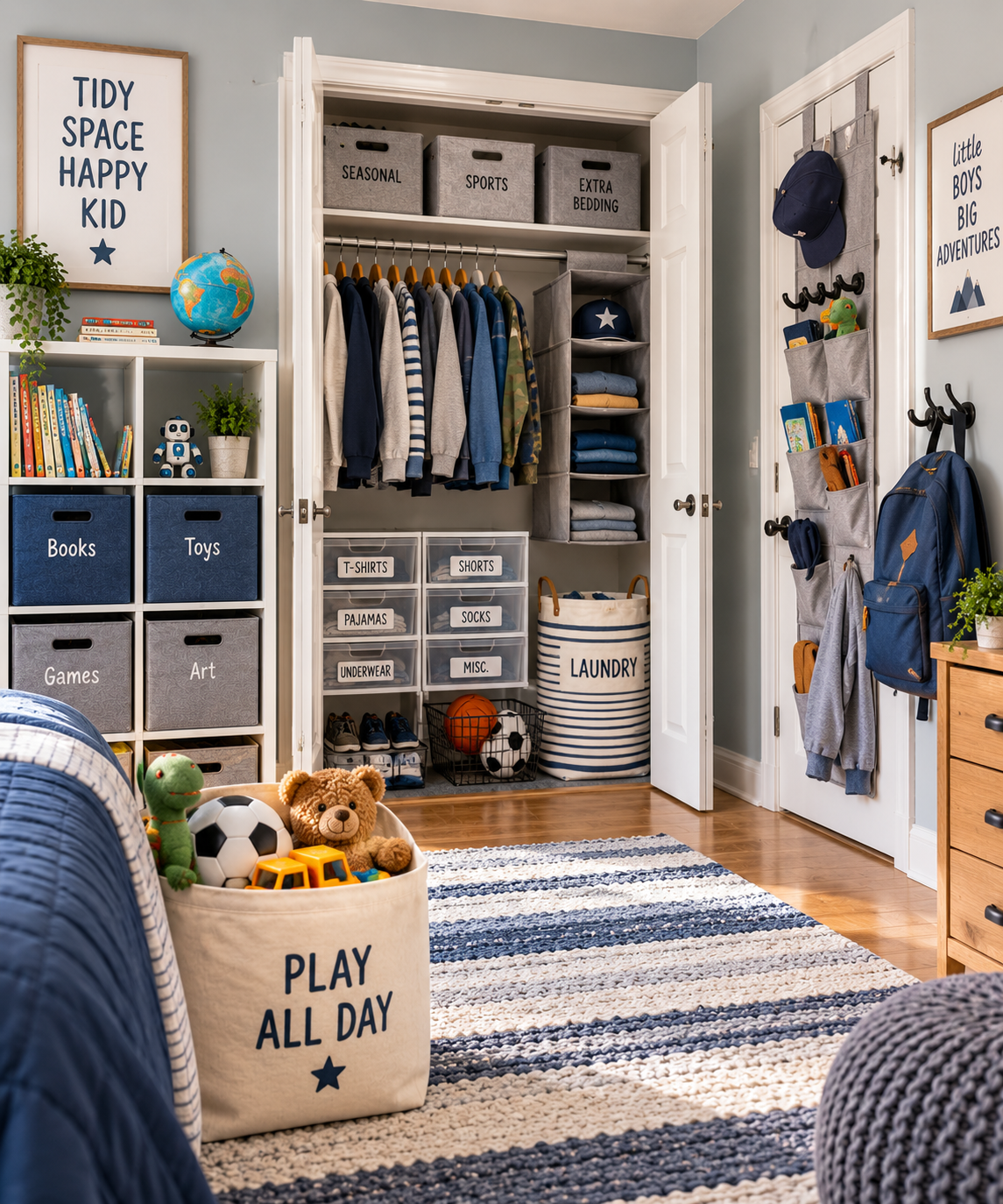
3. Give Books Their Own Easy-to-Reach Zone
A traditional bookcase isn’t the only way to store children’s books.
For younger kids, front-facing book ledges can work especially well because the covers are visible. Older children may benefit more from a compact bookcase that provides room for chapter books, reference books, school materials, and collectibles.
If floor space is limited, consider:
- Narrow bookcases
- Wall-mounted book ledges
- Cube shelving
- Bedside book baskets
- Floating shelves for less frequently used books
Try to keep at least some books within easy reach of the bed or reading area.
The goal isn’t just to make the room look organized. It’s to make reading convenient.
4. Use Cube Storage for Toys and More
Cube organizers are popular in children’s bedrooms for a good reason: the same piece of furniture can handle several different storage jobs.
One cube might hold books.
Another can contain a fabric bin filled with toys.
Another can display a favorite model or collection.
That flexibility makes cube storage particularly useful as children’s interests change.
If you use fabric bins, consider assigning broad categories instead of creating an overly detailed system. For example:
Cars | Building Toys | Art | Animals
Simple categories make cleanup faster.
For safety, tall or potentially unstable furniture should be properly secured according to the manufacturer’s instructions.
5. Make the Closet Work Harder
A closet with one hanging rod and one high shelf often wastes a surprising amount of space.
Before buying another storage cabinet, look at what can be improved inside the closet.
Depending on the layout, useful additions might include:
- A second hanging rod
- Hanging shelf organizers
- Small drawer units
- Shoe storage
- Shelf dividers
- Storage baskets
- Hooks
Children’s clothes are generally shorter than adult clothes, so there may be usable space underneath hanging shirts and jackets.
That lower section can become storage for shoes, folded clothing, backpacks, or toys.
6. Add Hooks Where Clutter Naturally Happens
Hooks are one of the simplest bedroom organization tools, yet they can solve several everyday problems.
Instead of expecting everything to end up inside a drawer or closet, put hooks where things naturally get dropped.
Good candidates include:
- Backpacks
- Hats
- Jackets
- Robes
- Small bags
- Sports gear
The important part is height.
A beautifully installed hook isn’t useful if the child can’t comfortably reach it.
A small row of accessible hooks near the bedroom door can sometimes prevent an entire chair from becoming the unofficial clothing storage system.
7. Use a Storage Bench for Bulky Items
Some things simply don’t fit nicely into small bins.
A storage bench or ottoman can provide a home for bulkier items while serving another purpose in the room.
It can work well for:
- Stuffed animals
- Blankets
- Larger toys
- Dress-up clothes
- Sports equipment
Place one at the foot of the bed, beneath a window, or along an unused wall if space allows.
Just be selective about size. In a small bedroom, an oversized storage bench can create more of a space problem than it solves.
8. Create a Simple Home for Dirty Clothes
Sometimes the biggest source of bedroom clutter isn’t toys.
It’s laundry.
A hamper placed where clothes are normally removed can make an immediate difference.
For most children, a simple open or easy-access hamper is preferable to an elaborate laundry sorting system.
If the bedroom is very small, consider a narrow hamper, corner design, or hanging laundry bag.
The organizing principle is simple:
Make the correct place for an item easier to use than the floor.
That principle applies to almost every storage solution in this article.
9. Use the Back of the Door
When floor space is limited, doors can provide surprisingly useful vertical storage.
An over-the-door organizer can hold smaller items such as:
- Accessories
- Art supplies
- Small toys
- Socks
- Hats
- School supplies
Over-the-door hooks can also provide a place for robes, bags, or tomorrow’s outfit.
However, don’t automatically fill every pocket simply because it exists. Too many small compartments can turn into places where forgotten clutter accumulates.
Use this space for items that actually have a purpose.
10. Create a Dedicated School Zone
If homework, school papers, pencils, and books regularly migrate around the bedroom, give them one defined home.
This doesn’t require a large desk.
A small school station might consist of:
- One desktop organizer
- A pencil cup
- A file holder
- A small drawer unit
- A shelf for school books
Keeping school supplies separate from toys also makes it easier to switch between playtime and homework.
If a desk has drawers, resist the temptation to fill every drawer with miscellaneous objects. Assigning a clear purpose to each storage area makes it much easier to maintain.
11. Use Wall Space Without Filling Every Wall
When the floor is crowded, the natural reaction is to move storage upward.
That’s useful—but it can go too far.
Floating shelves, pegboards, wall pockets, and hanging organizers can free up valuable floor space, particularly for:
- Books
- Collections
- Small toys
- Art supplies
- Display pieces
But covering every wall with storage can make a small room feel visually busy.
A better approach is to choose one or two vertical storage zones and leave some open wall space around them.
The room will still gain storage without feeling like a warehouse.
12. Create a “Quick Cleanup” Basket
Not everything needs a perfectly labeled permanent home.
Keep one medium-sized basket available for quick cleanup.
When it’s time to tidy the room, miscellaneous items can go into the basket temporarily rather than staying scattered across the floor.
The important word is temporarily.
Once or twice a week, empty the basket and return the items to their proper places.
This is particularly helpful on busy school nights when a perfectly organized room isn’t realistic but a clear floor would still be nice.
How to Choose the Right Storage for a Boy’s Bedroom
Before buying organizers, take a few minutes to look at what is actually creating the clutter.
If toys are everywhere, adding another bookshelf probably won’t help.
If clothes pile up on a chair, the problem might be an inaccessible hamper or an overstuffed closet.
If books collect beside the bed, perhaps that’s exactly where a small book basket belongs.
A useful order is:
1. Identify the clutter.
What repeatedly ends up in the wrong place?
2. Decide where those items are actually used.
Storage should be close to that location.
3. Choose the simplest storage solution possible.
Don’t create a complicated organizing system unless it’s genuinely necessary.
4. Measure before buying anything.
This is especially important for under-bed bins, shelving, closet organizers, and storage benches.
5. Leave some empty space.
A storage container doesn’t need to be filled simply because you own it.
Storage Ideas by Problem
If you’re not sure where to start, match the problem to the solution:
| The Problem | Try This |
|---|---|
| Toys covering the floor | Low open bins or cube storage |
| Too many stuffed animals | Large basket or storage bench |
| Books beside the bed | Bedside basket or narrow bookcase |
| Clothes on the floor | Easy-access hamper |
| Jackets and backpacks everywhere | Low wall hooks |
| Closet feels too small | Double rod or hanging organizer |
| No floor space | Wall shelves or door storage |
| School supplies scattered around | Dedicated school station |
| Seasonal items taking up space | Under-bed containers |
| Constant miscellaneous clutter | Quick-cleanup basket |
You don’t need every solution on this list.
In fact, using fewer storage systems usually makes a bedroom easier to maintain.
Start With the Biggest Problem, Not the Biggest Organizer
It’s easy to look at a messy bedroom and assume the solution is buying more storage.
Sometimes it is.
But sometimes the better solution is removing things that are no longer used, moving seasonal items elsewhere, or simply putting an existing basket in a more convenient location.
Start with the one type of clutter causing the biggest problem.
Fix that.
Then live with the new system for a week or two before adding another organizer.
A boy’s bedroom doesn’t need to look perfectly styled every day. It needs to work for the child who actually lives there.
The best storage system isn’t the one with the most bins, labels, or shelves.
It’s the one that’s simple enough to use every day.
✅ Last Updated on September 28, 2026 by BIG Smart Team