
A backyard may look attractive but still remain unused when the seating area receives strong afternoon sun, light rain interrupts outdoor meals, or there is no comfortable place to sit during the hottest part of the day.
A pergola and a retractable awning can both add shade, but they solve the problem in different ways. A pergola becomes a permanent part of the outdoor layout, while a retractable awning provides adjustable coverage attached to a wall or supporting structure.
The better option depends on how much shade you need, whether you want permanent construction, how exposed the area is to wind and rain, and how much maintenance you are prepared to handle.
Start with the Area You Need to Shade
Before comparing products or materials, identify the exact area where shade is needed.
Common locations include:
- A patio next to the house
- An outdoor dining table
- A poolside seating area
- A small deck
- A garden bench
- An outdoor kitchen
- A frequently used doorway
- A seating area in the middle of the yard
Measure the width and depth of the space, then observe how the sun moves across it during the day. Morning sun, midday sun, and low afternoon sun may enter from different directions.
Overhead shade may help at noon but provide limited relief when the sun is low. In that situation, side screens, curtains, plants, or a differently positioned structure may also be necessary.
What Is a Pergola?
A pergola is an outdoor structure made with vertical posts supporting beams or an open roof system. It may be freestanding or attached to a house.
Traditional pergolas have spaced roof slats that provide partial shade. Other designs may include:
- A fabric canopy
- A retractable cover
- Adjustable louvers
- Climbing plants
- Outdoor curtains
- Shade panels
- Polycarbonate roof panels
A pergola can define an outdoor room and become an important visual feature in the landscape.
A pergola may suit you when:
- You want a permanent outdoor structure
- The seating area is not directly beside the house
- You want to define a dining or lounge zone
- You plan to add lighting, curtains, or climbing plants
- You prefer an architectural feature rather than a temporary shade product
- You need support posts to create coverage away from a wall
A pergola may not be ideal when:
- The available space is very narrow
- You do not want posts in the patio area
- Local approval or structural work would create complications
- You need full rain protection from a basic open-roof design
- You want shade that can disappear completely when not needed
What Is a Retractable Awning?
A retractable awning is a fabric shade system that extends outward from a wall, roof edge, or supporting frame. It may be operated manually or with a motor.
When extended, it provides overhead shade. When retracted, the fabric folds or rolls back toward the building.
Retractable awnings are commonly used above:
- Patios
- Decks
- Windows
- Doors
- Outdoor dining areas
- Small business entrances
They are especially useful when the area needing shade is directly beside the house.
A retractable awning may suit you when:
- You want shade only at certain times
- The patio is attached to the house
- You want to keep the area open on cooler or cloudy days
- You do not want permanent posts in the yard
- You need a compact solution for a smaller patio
- You want to reduce direct sun near windows or doors
A retractable awning may not be ideal when:
- The seating area is far from a suitable wall
- The mounting surface cannot safely support the system
- The location regularly experiences strong wind
- You need a structure that remains open in varied weather
- You want to hang heavy lighting, plants, or curtains from the shade system
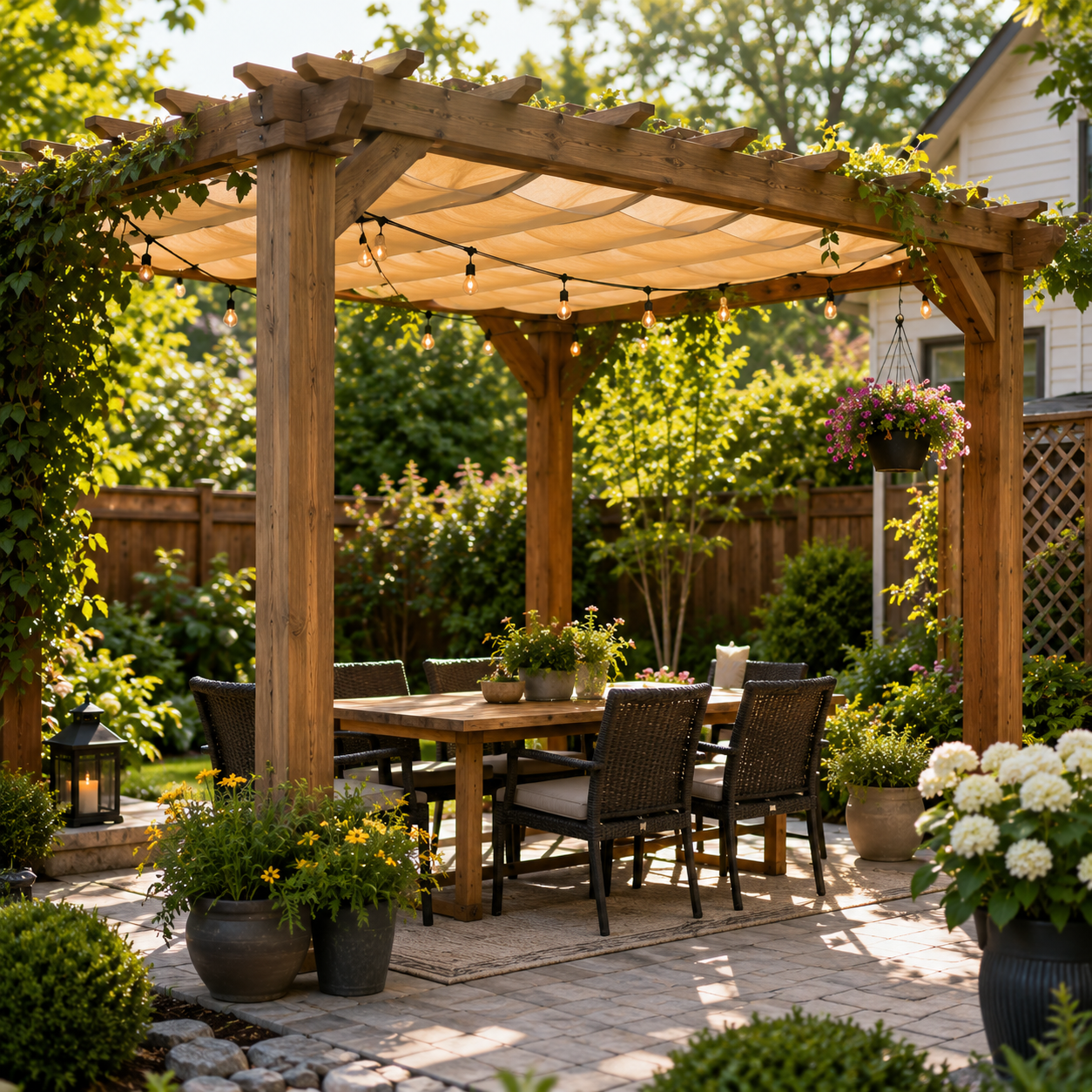
Pergola vs Retractable Awning at a Glance
| Factor | Pergola | Retractable Awning |
|---|---|---|
| Installation | Usually more involved | Usually mounted to a building |
| Support posts | Commonly required | Usually not required over the covered area |
| Shade control | Depends on roof design | Can be extended or retracted |
| Placement | Freestanding or attached | Usually attached to a suitable structure |
| Visual impact | Strong architectural feature | More compact appearance |
| Rain protection | Depends on roof material | Usually intended mainly for shade and light weather |
| Wind exposure | Depends on design and anchoring | Often must be retracted in unsuitable wind |
| Add-ons | Lighting, curtains, plants, fans | Some models support sensors or lighting |
| Maintenance | Depends on material and roof | Fabric and moving parts require care |
| Best use | Defined outdoor room | Adjustable shade beside a building |
Shade Coverage
A pergola does not automatically provide complete shade.
Open slats allow sunlight to pass through, and the amount of shade changes during the day. The direction and spacing of the beams affect how much sun reaches the space below.
For stronger shade, a pergola may need:
- A fabric canopy
- Closely spaced slats
- Adjustable louvers
- Shade cloth
- Outdoor curtains
- Climbing plants
A retractable awning generally creates a more continuous shaded area when fully extended. However, its protection depends on the projection, angle, fabric size, and position of the sun.
Neither option should be selected from appearance alone. Calculate where the shadow will fall during the hours when you plan to use the space.
Rain Protection
Many people expect an outdoor shade structure to work as a rain shelter, but shade and weather protection are not the same.
An open-roof pergola allows rain through. Adding a solid or adjustable roof may improve coverage, but drainage, structural loading, waterproof connections, and local building requirements then become more important.
A retractable awning may provide limited protection from light rain when the manufacturer allows it. It should not automatically be treated as a permanent roof. Water can collect on improperly angled fabric, and unsuitable weather may damage the arms, fabric, or mounting system.
Before purchasing either option, check:
- Intended weather use
- Required roof slope or awning pitch
- Drainage
- Wind limitations
- Snow limitations where relevant
- Manufacturer instructions
- Warranty exclusions
- Whether the system must be closed during bad weather
For a space that must remain dry in frequent heavy rain, a purpose-built roof or professionally designed covered structure may be more appropriate.
Wind Exposure
Wind is one of the most important factors when choosing an outdoor shade solution.
A pergola must be properly anchored and designed for its location. The roof style, attached screens, curtains, and solid panels can change how wind affects the structure.
A retractable awning creates a broad fabric surface when extended. Many systems must be retracted when wind becomes too strong. Some motorized models can work with wind sensors, but a sensor does not replace correct installation or attention to weather conditions.
If the yard is exposed, avoid assuming that a larger shade product is automatically better. A smaller, correctly installed solution may be more practical than a large structure that cannot be used safely during common local conditions.
Installation Requirements
Pergola installation
A pergola may require:
- Footings or concrete anchors
- Level ground
- Post placement
- Structural connections
- Drainage planning
- Utility checks
- Clearance from doors and windows
- Local approval
- Professional installation
A lightweight pergola kit may be simpler than a custom structure, but it still needs secure anchoring and a suitable surface.
Retractable awning installation
An awning may require:
- A strong mounting surface
- Correct bracket spacing
- Adequate installation height
- Clearance above doors and windows
- Correct projection angle
- Electrical access for motorized models
- Professional mounting
Siding alone may not provide sufficient support. The brackets generally need to connect to suitable structural material behind the exterior finish.
When structural mounting is uncertain, consult a qualified installer rather than relying on general installation assumptions.
Space and Layout
A pergola takes up physical space through its posts and frame.
This can be helpful because it creates a clear outdoor room. However, posts may interfere with:
- Walking paths
- Furniture placement
- Pool access
- Views
- Door movement
- Lawn equipment
- Drainage routes
A retractable awning leaves the floor area open because the shade extends from the building. This can work well on a narrow patio or deck where posts would make movement difficult.
However, the awning needs enough wall width and overhead clearance. Gutters, rooflines, windows, lights, vents, and exterior finishes may affect installation.
Appearance and Landscaping
A pergola can become a central design feature.
It may help an open backyard feel more finished by giving the seating area a defined shape. Materials and finishes can be coordinated with:
- Fencing
- Decking
- Outdoor furniture
- House trim
- Garden beds
- Pathways
A retractable awning has less visual weight. It may be a better choice when you want shade without adding a large permanent structure.
Fabric color matters because the awning is often visible from inside the house. Neutral colors can blend with the exterior, while stronger colors may become a focal point.
Avoid selecting a style without considering how it will look both extended and retracted.
Maintenance
Pergola maintenance
Maintenance depends on the material.
Wood may require cleaning, inspection, sealing, staining, or repainting. Metal structures may need checks for corrosion, loose fasteners, and damage to protective coatings.
Pergolas with fabric, louvers, gutters, or moving roof components require additional care.
Climbing plants may create attractive shade, but they also add:
- Leaf debris
- Pruning
- Moisture around the structure
- Insect activity
- Additional weight
- Access challenges for repairs
Retractable awning maintenance
An awning may need:
- Fabric cleaning
- Complete drying before long-term retraction
- Checks for tears or mildew
- Inspection of brackets and fasteners
- Lubrication or servicing where instructed
- Motor and sensor checks
- Removal of leaves and debris
Do not retract wet fabric for a long period unless the manufacturer provides specific instructions for doing so.
Cost Considerations
The final cost depends on size, material, installation, features, site conditions, and whether structural work is required.
A pergola may involve costs for:
- The structure or kit
- Footings
- Anchoring
- Installation
- Roof or canopy additions
- Lighting
- Curtains or screens
- Finishing
- Local approvals
- Long-term maintenance
A retractable awning may involve costs for:
- Fabric and frame
- Manual or motorized operation
- Mounting hardware
- Professional installation
- Electrical work
- Sensors
- Protective housing
- Replacement fabric
- Maintenance
Compare the complete installed system, not just the advertised product price.
A low-cost product may become expensive if it needs extra structural work or frequent replacement. A higher-priced system is not automatically better if it includes features you will rarely use.
Which Option Works Better for a Small Patio?
A retractable awning is often easier to fit over a small patio beside the house because it does not require posts in the usable area.
It can provide shade when needed and retract when you want more light.
A compact pergola may still work when:
- The patio needs stronger visual definition
- The wall is unsuitable for an awning
- The shade area is not directly beside the house
- You want curtains or climbing plants
- The posts will not obstruct movement
Measure furniture placement before choosing. The space should remain comfortable when chairs are pulled out and people walk around the table.
Which Option Works Better for a Pool Area?
A pergola may be more practical for a seating area positioned away from the house or beside a pool.
It can create a fixed zone for:
- Lounge chairs
- Towels
- Drinks
- Poolside dining
- Outdoor lighting
However, posts and footings must not interfere with circulation, safety barriers, drainage, or pool equipment.
A retractable awning may work when the pool deck is directly beside the house. It can shade a portion of the deck without adding posts near the water.
Pool areas may be subject to specific barrier, electrical, structural, and access requirements. Check local rules before placing a structure close to a pool.
Which Option Works Better for Outdoor Dining?
Both options can work for outdoor dining.
Choose a pergola when you want:
- A permanent dining zone
- Lighting above the table
- Curtains or screening
- A freestanding location
- A stronger architectural feature
Choose a retractable awning when you want:
- Flexible sun exposure
- An open patio when shade is unnecessary
- No posts around the dining table
- Coverage directly outside the kitchen or dining room
- A less permanent visual change
Remember to consider low-angle sun. An overhead cover may not shade everyone at the table during late afternoon.
What to Measure Before Buying
Record these measurements before comparing products:
- Width of the shade area
- Desired shade depth
- Patio or deck dimensions
- Distance from doors and windows
- Available wall height
- Roof and gutter clearance
- Furniture dimensions
- Walking clearance
- Distance from property boundaries
- Distance from pools or other structures
Also photograph the area at different times of day. This provides a more realistic picture of where shade is actually needed.
What Not to Buy Yet
Do not purchase a pergola or awning until you have checked:
- Sun direction
- Wind exposure
- Mounting or anchoring requirements
- Drainage
- Required clearance
- Local rules
- Installation costs
- Maintenance expectations
- Replacement part availability
- Warranty conditions
Avoid buying the largest available model before confirming that it fits the space and can be installed correctly.
You may also discover that the problem can be solved with a simpler option, such as:
- A patio umbrella
- A shade sail
- An outdoor curtain
- A small canopy
- Strategic planting
These alternatives have their own limitations, but they may be sufficient for an area used only occasionally.
Pergola or Retractable Awning: How to Decide
Choose a pergola when you want a permanent outdoor room, need shade away from the house, or want a structure that can support additional features.
Choose a retractable awning when the patio is beside a suitable wall, adjustable shade matters, and you want to preserve open floor space.
Neither option is automatically better.
The correct choice is the one that provides useful shade during the hours you need it, fits the available space, can be installed safely, and does not create more maintenance than you are willing to manage.
Explore backyard garden designs that make small outdoor spaces more useful
Link this CTA to the existing article:
Backyard Garden Designs That Make Small Outdoor Spaces More Useful
✅ Last Updated on September 28, 2026 by BIG Smart Team